What begins as a casual hobby—something that quietly takes up just one corner of your desk—can quickly grow into something much bigger. Before you know it, that simple pastime starts bringing in requests, opportunities, and income, and almost without warning, it becomes a professional pursuit.
That’s when reality becomes clear: the desk that once felt more than enough can no longer keep up with the pace, the tools, and the daily flow of your work.
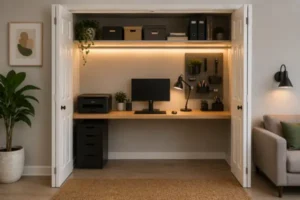
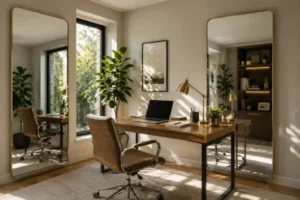
Turning part of your home—or even a small corner of your bedroom—into a genuinely productive workspace is entirely possible with the right choices. It doesn’t require major renovations or a large investment, but rather a more strategic way of using the space you already have.
In compact areas, every inch matters, and the way you arrange your tools and materials can make the difference between a functional setup and one that constantly feels overloaded.
For the Miniature Car Customizer, workspace organization is not just about aesthetics; it is a form of creative survival. In a tight environment, clutter does more than waste your time while you search for that tiny drill bit. It also drains the energy you need to create.
If you work from a bedroom corner or a small office desk, you have probably realized that horizontal space is limited. The solution is not to keep fighting for every inch of your tabletop, but to shift your perspective: stop depending only on the desk and start using your walls.
Vertical storage is the key to transforming a cramped area into a high-performance workshop, where everything you need stays within sight but out of the way of your hands.
Fundamentals of Vertical Storage: Making the Most of Every Inch
Effective vertical storage is not just about hanging items on the wall. It is about understanding how your body interacts with the space while you are focused on fine details. Precision matters. A shelf placed at the wrong height or built with the wrong depth can become more of an obstacle than a solution.
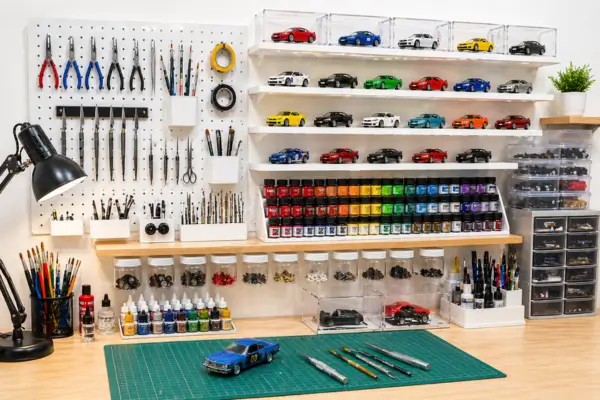
To begin, your Active Workflow Zone should sit at the heart of your wall setup. Ideally, your main supports, such as a tool panel, should be installed about 30 to 45 cm above your workbench. This range allows you to reach brushes or pliers without lifting your back from the chair, helping you keep your attention on the miniature.
If you install it too high, you will end up standing repeatedly, which breaks the rhythm of the work.
For displaying models, the ideal depth is around 10 cm. This is enough to comfortably hold 1:64 scale cars, and even some 1:43 models, either sideways or front-facing, without the shelf projecting too far over your workspace. Deeper shelves tend to create a canopy effect, blocking the light from your lamp and casting unwanted shadows exactly where you need clarity.
Keeping shelves shallow allows light to flow better and makes the entire space feel more open.
Smart Solutions for Tools and Paints
Instead of spreading everything across the desk, you can use modular systems that grow with your needs. A pegboard is one of the best allies for a customizer, but it needs to be used thoughtfully. Starting with 60 cm x 60 cm modules is a practical choice, as this size offers enough flexibility to organize everything from your airbrush to rolls of masking tape.
The main advantage is adaptability: whenever you add a new tool, you simply reposition the hooks.
For metal tools such as tweezers, hobby knives, and drill bits, a magnetic strip is one of the most efficient solutions. A 30 to 50 cm strip mounted directly on the wall or along the edge of the pegboard allows you to grab and return tools instantly, without opening drawers or searching through cases.
Paint storage presents a different challenge: being able to read labels without removing each bottle. The ideal vertical solution is a stepped rack, with each level about 4 cm wide. You can mount these supports on the wall or make them from cut PVC channels.
By arranging paints in tiers, you can clearly see each cap color and pigment name, organizing them by tone, such as warm, cool, or metallic shades. This saves valuable time that would otherwise be spent digging through boxes for that specific “chrome red.”
Planning and Design: Building Your Custom System
Before drilling into the wall, it is important to think about the volume and nature of your production. When integrating the workflow of a miniature car customizer into a vertical layout, the scale you work with most often matters. If you customize larger models, such as 1:24 scale cars, your display shelves should increase to 15 or 18 cm in depth.
For those focused on Hot Wheels and other 1:64 models, the shallow shelves mentioned earlier are ideal.
Safety also depends on details that should not be ignored. For masonry walls, use 6 mm or 8 mm wall plugs. If your workspace has drywall, always choose expansion anchors, such as toggle-style anchors, that open behind the panel. Keep in mind that the accumulated weight of a die-cast collection can be significant; 50 metal cars can weigh around 3 kg.
Without proper anchoring, you risk losing months of work in a single accident.
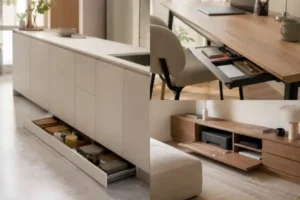
Strategies for “Invisible” Space and Protected Drying
In truly compact setups, even the air inside the workshop becomes useful space.
Using Enclosures for Vertical Drying
One of the biggest challenges in small environments is dust ruining fresh paint. The solution is to create a wall-mounted Protected Drying Station using clear acrylic boxes, approximately 15 x 10 x 10 cm, with front or top lids.
There is an important technical detail here: the lid is essential for blocking dust, but the box cannot be airtight. Ideally, you should drill 3 or 4 tiny holes, using a 2 mm drill bit, along the sides of the box. This allows solvent gases from the paint to escape, preventing the finish from becoming tacky or taking days to cure.
At the same time, the closed lid keeps pet hair, dust particles, and debris away from your varnish. Mounting these boxes on the wall frees up your bench and keeps the project protected while it dries.
Suspended Storage Beneath Shelves
If you already have wooden shelves, you also have a hidden second layer of storage. That gap between the underside of the shelf and the desk surface may seem insignificant, but it can have a major impact on daily use.
This is where transparent plastic containers with screw-on lids come into play. They can be repurposed from several sources, such as spice jars, baby food containers, or even thoroughly cleaned paint containers. The important thing is that they are transparent, because this completely changes how you interact with the space. You do not need to open anything to know what is inside.
The installation process is simple. The lid stops being just a closure and becomes the anchor point. It is positioned on the underside of the shelf and secured with small screws, preferably around 12 mm long, to avoid piercing through the wood. After that, the container, already filled with organized items, is simply screwed into the fixed lid.
Components such as custom wheels, delicate axles, tiny screws, cut decals, or interior details finally have a defined place. They are no longer scattered across the desk or hidden inside boxes that are difficult to access. Instead, they remain suspended, visible, and almost integrated into the structure of your workspace.
Transition Zones (WIP)
Create a small side “parking” shelf, about 20 cm wide, for projects waiting on a specific part. Having a designated area for Work in Progress, or WIP, prevents your main desk from feeling constantly crowded and allows you to start and finish smaller projects with more agility.
Implementing Creative and DIY Solutions for Miniature Car Customizers
Customizing your workspace can be just as detailed as customizing your cars. If your budget is limited, 50 mm electrical cable channels mounted horizontally on the wall can work extremely well. They have the right width for organizing acrylic paint bottles while keeping them secure and visible.
On the pegboard, one of the best ways to preserve your materials is to store long tools vertically. Use sewing elastic stretched between two hooks to create holders for your brushes. This prevents the bristles from touching any surface, helping the fine tips last much longer — something essential for anyone who paints headlights, grilles, and other small details.
“In the world of miniatures, the size of your talent is not limited by the size of your desk, but by how intelligently you organize your sanctuary.”
Switching to a vertical storage system is like gaining a new desk without having to buy one. By applying precise measurements, such as 10 cm deep display shelves and an active zone installed around 40 cm above the work surface, you remove the physical barriers that interrupt creative flow.
If your current workspace makes you feel boxed in, start by looking up. Choose one wall, install your first support using these technical guidelines, and notice how much difference freedom of movement brings to your hands. An organized environment is the best invitation for your next custom project to come to life. Ultimately, for those who create entire worlds in miniature, no detail is too small to be overlooked — especially the place where the magic happens.