Remote work has changed the way we use our homes, creating a growing need for what can best be described as spatial flexibility. In smaller living spaces, shifting between rest and productivity has become a real design challenge.
This is where modular and foldable furniture becomes especially valuable — an approach that treats organization as a flexible system, allowing a single room to change purpose within minutes without sacrificing style.
The ability to create a functional workspace in almost any corner of the home has become essential to modern living. In this context, organization is no longer just a matter of tidiness; it is the strategy that makes a temporary office possible without letting limited square footage restrict productivity.
The furniture itself determines how efficient this daily transition will be, and the intelligence behind that decision lies in the engineering of modular systems.
How Modular and Foldable Furniture Adapts to Modern Living
In home office furniture, there is a crucial distinction between a standard piece and a modular system. While traditional furniture remains static, modular systems are built around expandable units that can evolve as needs change.
This scalable approach prevents an initial setup from becoming visually cluttered or functionally outdated within a few months.
Modularity also allows homeowners to make better use of corners, narrow areas, and awkward layouts that conventional furniture often ignores. Through adaptable configurations and lighter structural solutions, these systems maximize every centimeter without overwhelming the room visually.
Rather than relying on bulky fixed pieces, modular design introduces flexibility that allows the workspace to fit more naturally into the rhythm of everyday domestic life.
The true value of modular furniture lies in its ability to evolve alongside the user’s routine and professional growth. Yet spatial optimization is not limited to floor space alone. Strategic vertical design is often what truly unlocks the potential of a compact environment.
Discover how wall surfaces can become powerful allies in creating a functional and discreet home office setup.
Pivoting Surfaces and the Rise of the “Wall Office”
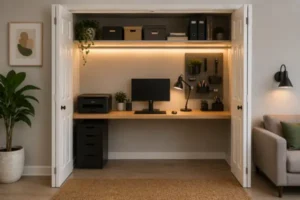
In compact home offices, the wall becomes one of the most valuable surfaces available. Pivoting systems such as Murphy-style desks represent a major step forward in spatial efficiency by embracing the idea of a near “zero-footprint” workstation.
The innovation is not simply that the desk folds away, but that the interior structure itself can function as a fully organized work hub.
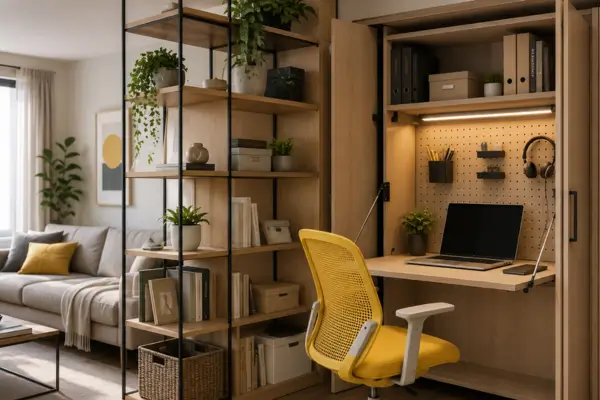
Inside these vertical workstations, perforated panels, magnetic supports, and integrated cable management systems allow monitors and accessories to remain connected even when the desk is closed. High-pressure gas pistons help ensure smooth and secure movement, turning an ordinary wall into a complete workstation within seconds.
Once folded away, the structure blends naturally into the surrounding cabinetry or décor, preserving the visual harmony of the room and reducing the sense of clutter often associated with remote work.
This approach creates a smoother transition between work and rest, treating the wall not as a passive boundary, but as an active part of the home’s functionality.
At the same time, intelligent spatial design also requires clear boundaries within open or multifunctional interiors.
Learn how to define focus areas without building walls, using only the strategic zoning capabilities of modular design.
Zoning Without Walls — Modular Shelving as Spatial Dividers
Wall-free zoning uses modular shelving systems as subtle flow dividers, allowing work areas to be visually separated without sacrificing openness or natural light. Open shelving with low-profile metal frames or textured laminate finishes creates a gentle boundary between relaxation zones and productivity zones while maintaining ventilation and visual continuity.
One of the greatest advantages of these systems is flexibility. Modules can be rearranged as routines evolve, making it possible to adapt circulation patterns and redefine spaces intuitively over time. It is an elegant solution for establishing a dedicated work territory while preserving the fluid atmosphere of the home.
Choosing shelving systems that can evolve and transform is ultimately an investment in long-term versatility. However, their effectiveness depends heavily on the quality of the mechanical components behind them.
Discover why durable hardware is the deciding factor in preventing your home office organization system from becoming a source of frustration over time.
Hardware and Longevity — The Mechanics Behind Organization
The effectiveness of foldable furniture is directly connected to the quality of its hardware. Soft-close concealed hinges, full-extension telescopic rails, and reinforced locking systems are the silent mechanisms that sustain everyday organization.
These components form the mechanical foundation of an efficient workspace. Inferior hardware can eventually warp, stick, or lose alignment, creating frustration and encouraging objects to accumulate on surfaces that were meant to remain flexible and mobile.
Investing in carbon steel components or anodized aluminum structures helps ensure that desks continue folding smoothly and shelves remain stable under regular use. The ease of transitioning between work mode and living mode depends on how well these systems endure repetitive opening and closing throughout the day.
A single overlooked mechanical detail can turn a smart solution into a daily obstacle, compromising both comfort and visual order. Long-term organization begins with materials designed to withstand the realities of modern remote work routines.
Still, the ultimate test of an efficient temporary office is not only how well it functions during the day, but how completely it can disappear once the workday ends.
Explore the logistical strategies that allow an office to vanish almost invisibly, restoring the home to its original sense of calm and comfort.
The “Ghost Office” Protocol — The Logistics of Disassembly
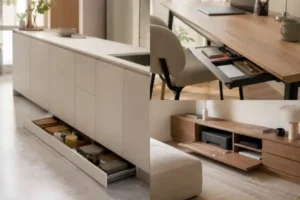
The concept of the temporary office reaches its highest level of efficiency through what can be called the Ghost Office Protocol, an approach focused on after-hours disassembly logistics. Foldable furniture alone is not enough; the surrounding “residual spaces” must also be strategically mapped.
Narrow gaps between cabinets, the area beneath a sofa, or even the unused space behind doors can become storage zones for folding chairs, laptop stands, and portable accessories. Standardized measurements within modular systems make stacking and storing components far more efficient, maximizing every cubic centimeter available.
The objective is simple: allow the home to return fully to its role as a place of rest without leaving visible traces of work behind. Eliminating visual clutter reduces cognitive fatigue and helps preserve the psychological separation between professional responsibilities and personal life.
When this process becomes habitual, putting the office away no longer feels like a chore. Each object has a designated place, and the act of dismantling the workspace becomes almost automatic. In many ways, the art of the temporary office is not just creating a workspace quickly, but making it disappear just as effortlessly.
Once this logistical rhythm is mastered, organization stops feeling like maintenance and becomes a practical advantage built naturally into the home.
In the end, turning an ordinary room into a temporary office shows that organization is what separates an improvised setup from a truly functional workspace. Modular and foldable furniture may provide the tools, but strategic organization is what delivers meaningful results.
By embracing scalable systems, pivoting surfaces, intelligent zoning, and durable hardware, it becomes possible to create an environment that actively supports both productivity and comfort. In modern compact living, flexibility is no longer a luxury — it is a necessity for maintaining balance between professional efficiency and personal well-being.
The real issue is rarely the size of the room itself, but how intelligently the space is designed to adapt to daily demands. When organization is approached as a strategic asset rather than a decorative afterthought, every part of the remote work routine becomes more fluid, sustainable, and functional.