For a long time, wall color was treated as a purely aesthetic choice. However, with the rise of remote work and the need to turn small spaces into productive environments, color psychology has gained relevance as a strategic tool within the workspace.
This shift didn’t happen by chance. Over the past few decades, research in environmental psychology and neuroscience has shown that the visual environment around us has a continuous impact on the brain. In compact spaces—common in most homes—this effect becomes even more noticeable.
Today, paint is no longer just a decorative detail. It directly influences behavior, attention, and cognitive performance. Understanding this evolution makes it possible not only to create a more pleasant environment, but to intentionally shape a space that supports focus and productivity.
From Aesthetics To Function: When Color Began To Influence Work
In the early 20th century, work environments were designed almost exclusively around operational efficiency. Industrial and administrative offices relied heavily on neutral tones such as white, beige, and gray—not out of aesthetic preference, but for standardization and ease of maintenance. Color was not considered relevant to human performance.
This perspective began to shift in the second half of the century, when early studies in environmental psychology emerged. Researchers started to explore how physical elements of a space—including color, lighting, and layout—could influence behavior and productivity.
Among these studies, the work of Nancy Kwallek stands out. In experiments conducted at the University of Texas, she observed that workers exposed to different color environments showed variations in mood, mental clarity, and concentration. Highly neutral settings, for instance, were linked to lower cognitive stimulation in certain types of tasks.
Findings like these helped redefine the role of color in the workplace. From that point on, it began to be seen as a functional element—capable of continuously influencing mental states.
With the arrival of remote work, this shift became even more relevant. Unlike traditional offices, home environments require constant adaptation, especially in smaller spaces. Walls are no longer just a visual backdrop—they have become an active part of how the space is structured and experienced.
What Science Shows About Color And Cognitive Performance
The relationship between color and behavior is not just a subjective impression. A growing body of research shows that visual stimuli directly affect how the brain functions, particularly in areas related to attention and emotional regulation.
Research available through scientific databases associated with the National Institutes of Health, including PubMed, suggests that exposure to different colors can influence levels of brain arousal and emotional response. PubMed brings together peer-reviewed studies from universities and research centers around the world, especially from the early 2000s onward.
This body of evidence suggests that the visual system is closely connected to regions involved in decision-making, mental processing, and sustained attention.
One of the most frequently cited studies in this field was conducted by Ravi Mehta and Rui Zhu and published in 2009 in the journal Science. The research, carried out at the University of British Columbia in Canada, examined how different colors influenced performance on mental tasks.
The results showed that red tends to enhance attention to detail and accuracy in specific activities, while blue supports creative processes and more open-ended thinking. However, the study also found that red may increase mental tension when sustained focus is required over longer periods.
Another important point is that the effects of color are neither universal nor absolute. Scientific reviews published in international medical databases over the past decade show that the impact of color varies depending on context, intensity, lighting conditions, and the type of activity being performed.
In other words, there is no single “ideal” color for productivity—the outcome depends on how it is applied within the environment.
This nuance becomes even more significant in small spaces, where the visual field is limited and any stimulus tends to feel stronger and more constant.
How Different Colors Influence Focus In Small Environments
When these findings are applied in practice, it becomes clear that the impact of color in compact spaces goes far beyond aesthetics. Intensity, saturation, and proportion all directly shape how the brain responds to the environment.
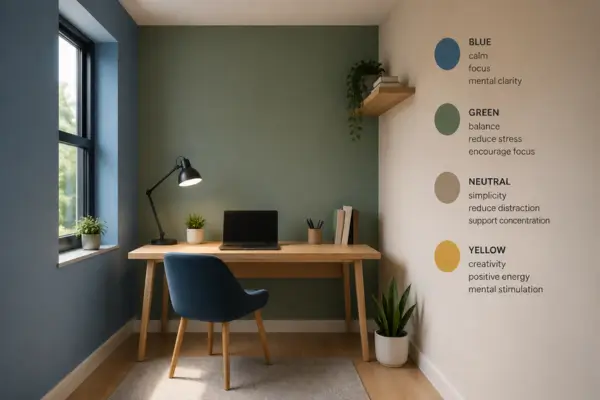
Blue, for example, is often associated with calm and stability. Research suggests it can help maintain consistent levels of attention over time, making it particularly suitable for analytical tasks or work that requires prolonged concentration. In smaller spaces, softer shades of blue tend to reduce visual overload.
Green produces a similar effect, with an added benefit: it is closely linked to reduced visual fatigue. Studies indicate that exposure to green can help maintain visual comfort during extended work sessions, which is especially valuable in environments where people spend many hours focused on screens or detailed tasks.
Red, on the other hand, acts as a more intense stimulus. It increases alertness and can be effective in small doses, particularly in areas that require immediate attention. However, when used across large surfaces, it may create tension and make sustained focus more difficult.
Yellow is associated with mental stimulation and a sense of energy, but it also requires careful use. In small environments, highly saturated tones can become distracting, while softer variations can keep the mind engaged without overwhelming the visual field.
One key insight from recent research is that in compact spaces, the intensity of a color often has a greater impact than the color itself. Balanced, softer tones tend to support focus and longer periods of engagement, while overly vibrant colors may lead to overstimulation.
Applying Color Psychology To Workspace Organization
When these ideas are put into practice, color moves beyond personal preference and becomes part of a more intentional approach to organizing space.
In smaller environments, where there is often no clear physical separation between areas, color can be used to create visual zones. A main wall in a soft shade of blue or green, for instance, can define the workspace, while neutral tones on surrounding surfaces help minimize distractions.
Another effective strategy is partial painting. Applying color to just a portion of the wall—such as half-height coverage or vertical sections—creates visual structure without compromising the sense of openness. This approach works particularly well in compact settings, where every visual element influences how the space is perceived.
In addition, organizing a space through color helps reduce cognitive load. When the environment feels visually balanced, the brain processes fewer irrelevant stimuli, making it easier to maintain focus over time.
More than choosing a specific color, the key lies in the intention behind the choice. Wall paint becomes a subtle yet consistent tool—one that guides behavior and supports attention in the background.
In a home office, this represents a clear shift: the space is no longer simply adapted, but deliberately designed to support the way work actually happens.
Color has never truly been neutral—it was simply overlooked for a long time.
What we now understand about visual perception and cognitive response makes it clear that color plays an active role in how the brain interprets a space and distributes attention throughout the day. In small environments, this effect is not subtle; it is constant.
Once color becomes part of how a space is organized, the environment moves beyond basic functionality and begins to carry intention. Visual noise is reduced, spatial clarity improves, and a more stable foundation for focus naturally emerges.
Ultimately, it’s not the color itself that transforms a space, but the intention behind how it’s used. When applied with purpose, paint stops being a background detail and starts shaping how work naturally unfolds within that environment.