What often begins as a simple hobby something done in spare moments, without major expectations—can gradually take on a different scale. Opportunities start to appear, requests come in, and that is usually when the first doubt surfaces: “I don’t have enough space for this.”
The idea of needing a larger area, or even renting a separate workspace, can quickly become a barrier. With it comes an unnecessary sense of pressure before the work has even truly begun.
What is not always obvious is that the space you need may already exist inside your own home. A small room, when thoughtfully arranged, is not a limitation. It can become a functional workspace where production flows with consistency.
More than finding extra space, the real point is understanding how to structure what is already available. When each area is designed around a specific task, the room begins to support the work instead of getting in the way. And that shift can completely change how you see the beginning.
Reframing the Space: From Bedroom to Micro Atelier
A common mistake in small rooms is treating the bedroom as a generic area, where several functions overlap without clear intention. This often leads to clutter and makes even simple tasks feel slower and more tiring.
When that same room is understood as a micro atelier, it stops feeling improvised and begins to serve a defined purpose. This change in perspective is what makes efficient organization possible.
From there, the layout should follow the real sequence of the work: cutting, preparing, sewing, finishing, and storing. This order reduces unnecessary movement, prevents interruptions, and brings more rhythm and predictability to the routine.
Defining Zones: Building a Functional Workspace
In a space of approximately 2.00 m by 2.50 m, dividing the room into specific zones is not just a detail. It is what allows the work to happen without constant disruption.
Fixed Production Zone
The sewing machine area needs a permanent position. In a small setup, assembling and putting away the machine after every use interrupts the rhythm and creates avoidable fatigue.
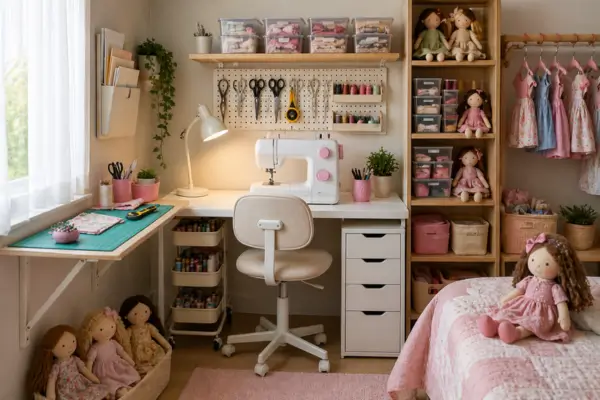
The table should be chosen according to real use. A width between 90 cm and 110 cm, with a depth of 45 cm to 50 cm and a height between 74 cm and 76 cm, provides enough stability for the machine while still leaving usable space to guide the fabric.
Machine placement also benefits from a practical logic. Instead of centering it, placing it slightly to the right for right-handed users allows better fabric control, leaving about 20 to 25 cm free on the right side and 50 to 60 cm on the left. This arrangement follows the natural movement of the fabric, reducing tension and improving control even when working with very small pieces.
Even in a compact room, it is important to allow at least 60 cm behind the chair for comfortable movement, along with small side clearances to avoid obstruction during use.
The chair should follow the same proportion. A seat height between 45 cm and 50 cm helps maintain comfort and freedom of movement at the table.
Preparation Zone: A Flexible Surface Without Compromising Circulation
Cutting and adjusting pieces require a clear, stable surface, but in a room of up to 5m², this area cannot take up permanent space.
Improvised solutions may work for a while, but they often require constant adjustments and interrupt the flow of the work. For this type of compact setup, a wall-mounted folding table is usually a more efficient option.
When open, it provides a firm surface for cutting. When closed, it frees up the circulation area completely, which makes a noticeable difference in daily use.
For doll clothing, a width between 70 cm and 90 cm and a depth between 40 cm and 50 cm are enough for precise work without occupying more room than necessary.
The most important point, however, is how this surface is used. In a small environment, every element needs a clear function. The preparation table should be used only during cutting and kept clear when closed. Avoiding accumulation reduces the time spent reorganizing and helps keep the workspace efficient.
Storage Zone: Vertical and Selective Strategy
Storage is not only about putting things away. It is about keeping the room ready to work. When materials accumulate without order, the space stops supporting the process.
Organization begins by separating what is used daily from what stays in reserve.
Everyday items such as thread, buttons, and small notions work better in modular drawers with internal dividers, around 10 to 15 cm deep. This makes everything easier to see and prevents materials from mixing.
Tools can be arranged on wall-mounted pegboards, positioned 40 cm to 60 cm above the table. This frees the work surface while keeping essential items within reach.
Rolling carts, around 30 cm wide and up to 80 cm high, help maintain flexibility inside the room and can be moved as needed.
Less frequently used materials should be stored higher up. Stackable transparent boxes, between 25 cm and 35 cm high, make identification easier without requiring constant rearranging.
Shelves above 1.50 m use vertical space without interfering with circulation, while areas under the bed or table can hold boxes up to 20 cm high for bulkier items.
Pattern Organization: Precision in Small Formats
In doll clothing sewing, patterns are a direct part of the process. When they are not properly organized, they can get mixed together, creased, or even lost, which may lead to unnecessary rework.
Because they are small, it is easy to underestimate how carefully they should be stored. Yet their size is exactly what makes control more important. Loose stacking or mixing them with other materials affects both preservation and speed of use.
The most efficient method is vertical storage. Slim plastic folders, organizing envelopes, or file-style dividers help prevent creases and make each model easier to identify.
Grouping patterns by garment type—dresses, tops, pants—reduces selection errors and makes it easier to repeat designs that have already been tested. These sets can be stored in vertical niches between 25 cm and 30 cm wide or in wall-mounted magazine holders.
Keeping patterns close to the preparation area makes them easier to access during cutting. With clear labeling, their use becomes direct and natural, fitting smoothly into the sequence of work.
Organizing the Workflow
In a space of up to 5m², organizing the room is not enough. The work also needs to move in a clear sequence.
Doll clothing sewing usually follows a direct process: cutting, sorting, sewing, and finishing. When these stages overlap, the rhythm of the work is lost.
One effective way to avoid this is to arrange the space so it follows the process itself. This creates a functional order, where each movement supports the next step.
After cutting, the pieces should be placed in a shallow tray, up to 5 cm high, positioned to the left of the machine. This becomes the entry point of the process.
During sewing, only the piece being worked on should remain in the central area of the table. This prevents buildup and keeps attention on the task.
Finished pieces should be moved to a container on the opposite side, creating a clear separation between what is in progress and what has already been completed.
This flow—entry on the left, execution in the center, and output on the right—keeps the work continuous, even in a limited area.
Minimal Circulation and Space Maintenance
In a compact room, circulation needs to be planned from the beginning. Each movement should happen without effort or constant adjustment.
Leaving enough room to open drawers, move the chair, and reach materials keeps the setup practical over time.
Maintenance is part of this system. When every item has a defined place, keeping the room organized becomes much easier.
Small habits, such as putting materials away after use and keeping surfaces clear, are enough to preserve the efficiency of the workspace.
Ultimately, when a work opportunity appears, it is common to look outward and imagine that a larger studio, a separate room, or a different structure is necessary in order to begin. But in many cases, the starting point is already inside your own home.
A room of up to 5m² may not seem sufficient at first glance, but when it is organized with intention, it can meet the exact needs of the task. It is not the size of the room that determines whether it works, but the way the space is planned.
Once you start looking at your own home with that understanding, the perception changes. What once seemed insufficient can become the place where your work develops with consistency, within your own reality.