In a world where remote work has become a lasting reality, the home increasingly doubles as an office. Yet domestic spaces are not always designed for this transition, especially when it comes to dedicated work areas.
Many people find themselves adapting a bedroom corner, part of the living room, or even a hallway into a productive workspace.
After hours spent facing nearby walls, tight furniture layouts, and limited room to move, the mind can begin to perceive the environment as heavier than it really is. The feeling of confinement, the lack of perspective, and the constant proximity of objects may gradually reduce focus, increase mental fatigue, and even affect creativity throughout the day.
The human brain responds strongly to spatial cues. Environments that suggest depth, light, and continuity tend to create greater comfort and mental clarity. This is where the mirror moves beyond decoration and becomes a powerful tool for shaping the work environment.
It does more than reflect images it influences light, depth, and spatial perception, subtly changing how the brain interprets the room.
The goal here is to show how the intelligent use of these elements can reshape visual perception. Gradually, a compact space stops feeling restrictive and begins to create a sense of openness, balance, and focus.
In many cases, a simple change in positioning is enough to completely transform the experience of working from home.
The Infinite Window Positioning Technique
Imagine having an extra window in your home office one that takes up no physical space but expands natural light and creates a more open atmosphere. That is the idea behind the technique often called the “infinite window.”
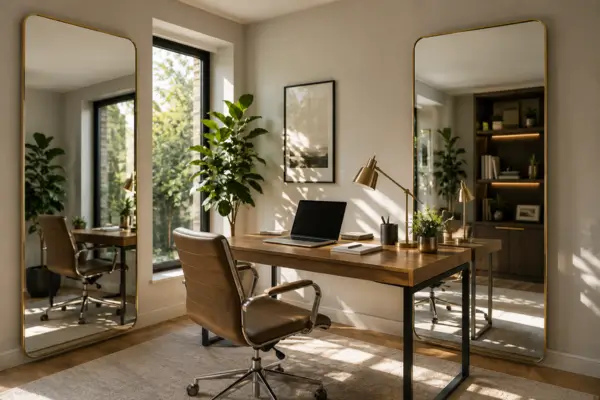
The concept involves placing a mirror perpendicular to an existing window. The reflection creates the illusion of continuity, making natural light appear to spread further throughout the room. In small offices set up inside bedrooms, integrated living spaces, or narrow corridors, this strategy can create a noticeable difference within the first few hours of use.
There is a significant distinction between reflecting a static wall and reflecting natural light. A wall simply duplicates the room’s visual boundary, while light introduces movement, depth, and a sense of openness. The space begins to feel lighter rather than enclosed.
Beyond aesthetics, there is also an important psychological effect. Indirect visual contact with the outside world helps reduce the feeling of isolation, something common during long remote work routines. Even in compact environments, the brain starts interpreting the room as less restrictive.
This effect becomes even more powerful when combined with organized surfaces and visually clean areas, allowing spaciousness and order to work together naturally.
Strategic Reflection of Organized Areas
Compact spaces demand constant organization. In smaller environments, just a few misplaced objects are enough to create visual overload. Mirrors can help not only by making the room appear larger, but also by reinforcing the perception of order.
One of the most effective approaches is positioning mirrors so they reflect organized areas such as shelves, niches, bookcases, or minimalist surfaces. When the brain detects symmetry and structured repetition, the environment tends to feel more balanced and spacious.
In small apartment offices, for example, reflecting a neatly arranged shelf can create an elegant sense of continuity while softening the impact of the room’s physical limits.
There is, however, an important detail: a mirror amplifies exactly what it reflects. If it faces exposed cables, piles of paper, or excessive clutter, it will visually double the disorder. The psychological impact is usually immediate, making the environment feel heavier and mentally exhausting.
For that reason, curating the reflection is just as important as choosing the mirror itself. In many situations, reorganizing a small section before positioning the mirror produces a far more sophisticated result than simply adding another decorative element.
Another useful solution is placing mirrors at the back of open shelving units. This creates extra depth within the furniture and reduces visual heaviness, especially in rooms filled with vertical storage structures.
Expanding Visual Horizons with a Background Mirror
Working while facing a wall can become mentally draining over time. In compact home offices, this constant limitation often creates a sense of monotony and mental blockage.
The “background mirror” technique offers a simple yet highly effective way to break that sensation without requiring structural changes to the room.
The strategy involves placing a horizontal mirror above the monitor or on a nearby side wall. Instead of directly reflecting the user, it creates a sense of continuity by revealing parts of the environment that would normally remain outside the field of view.
The effect is subtle, but remarkably efficient. The wall stops functioning as a closed barrier, and the brain begins interpreting the room as more open and dynamic.
In small workspaces improvised inside bedrooms, this technique can significantly reduce the feeling of confinement. Many people notice that the room feels lighter and less restrictive after installation.
There is also a practical advantage. A mirror broadens awareness of the surroundings, allowing movement in the environment to be perceived without constantly turning the head. This creates a greater sense of spatial comfort during long working hours.
When combined with proper lighting, the background mirror stops being purely decorative and becomes part of the workspace’s visual architecture.
Lighting and Clarity: Mirrors as Focus Enhancers
Lighting directly influences concentration, mental performance, and energy levels throughout the day. In smaller environments where natural light does not always reach every corner, mirrors can function as powerful light amplifiers.
By reflecting daylight or strategically positioned lamps, they redistribute brightness throughout the room and reduce shadowed areas that often make a space feel heavy.
This detail becomes especially important in compact home offices located in darker parts of the house. A dim corner can create a sense of fatigue long before the body is actually tired.
When light spreads more evenly, the environment gains a cleaner, lighter, and more organized atmosphere. The brain naturally interprets brighter spaces as more comfortable and welcoming for long periods of concentration.
There is, however, one important precaution: avoiding glare on screens or directly into the eyes. The ideal approach is observing how natural light behaves throughout the day before deciding on the mirror’s final position.
In many cases, small angle adjustments completely solve the issue. The goal is not to create excessive brightness, but to improve clarity without causing discomfort.
With balanced lighting, even a limited workspace begins to feel calmer, clearer, and more productive.
Geometry and Proportion: Choosing the Right Shape
The shape of a mirror directly affects how a room is perceived. In compact offices, this choice can completely alter the visual balance of the environment.
Vertical mirrors help elongate the room, creating the impression of higher ceilings. They work especially well in spaces where the ceiling feels low or where furniture occupies too much of the visual field.
Horizontal mirrors, on the other hand, visually widen the room and make walls appear farther apart. In narrow offices, this often creates an immediate feeling of openness.
The right choice depends on which proportion of the room needs softening.
Frames also deserve careful attention. In compact home offices, thin frames or frameless mirrors usually work better because they preserve visual lightness. Heavy structures can turn the mirror into an overly dominant feature, producing the opposite effect.
In smaller environments, sophistication often comes from fluidity. The less the eye feels interrupted by visual obstacles, the greater the perception of spaciousness tends to be.
When chosen carefully, a mirror stops being a simple decorative accessory and becomes part of the room’s visual organization itself.
In the end, mirrors can transform far more than the appearance of a compact home office. When positioned strategically, they alter light, depth, spatial perception, and even the way the mind responds to the work environment.
The simulation of windows, the visual reinforcement of organization, the expansion of sightlines, and the enhancement of lighting demonstrate how small adjustments can create meaningful changes in daily routines. In many situations, the physical space remains exactly the same but the experience of being inside it changes completely.
This transformation happens because visually balanced environments naturally reduce the feeling of mental overload. Once the eye encounters more depth, clarity, and organization, the mind tends to respond with greater comfort and focus.
Ultimately, perhaps the most interesting aspect of these strategies is that they do not require major renovations or expensive investments. Sometimes, repositioning a single mirror is enough to completely change how a workday begins.