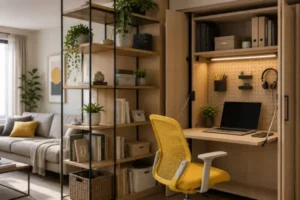
Working from home doesn’t always come with the luxury of a dedicated workspace. In reality, many people rotate between the kitchen table, a corner of the couch, or whatever surface happens to be available.
At first, it feels manageable—but over time, the downsides become clear. Constant setup and teardown, unfinished arrangements, and a lack of consistency start to affect focus.
That was exactly what led me to reconsider a space that had always been there, but had never been used with intention: the closet.
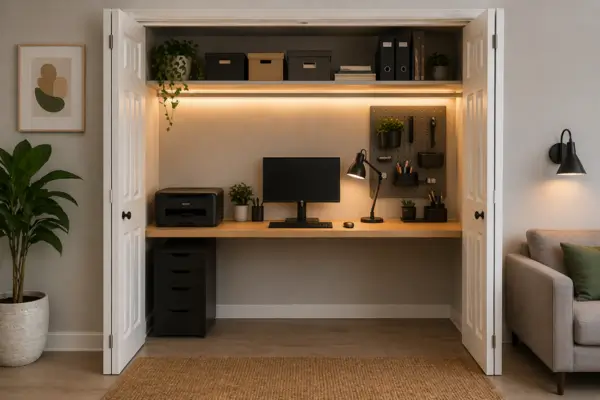
The idea behind a ClOffice (Closet Office) isn’t about creating something new—it’s about rethinking what already exists. When done right, it turns an overlooked space into a workspace that is not only usable, but consistent and practical in everyday life.
The Impact of a ClOffice: More Than Just Saving Space
A ClOffice does more than free up space—it creates a clear boundary between work and personal life, something that has become increasingly important when working from home.
Research in environmental psychology shows that our surroundings shape how we think and behave. When everything happens in the same place, the brain starts to blur those roles. Even a small, defined workspace can shift that dynamic, helping you stay more organized throughout the day.
This isn’t just theoretical—this separation directly affects how consistently the space gets used in real life.
There’s also something powerful in the act itself: opening the closet to begin work and closing it when the day ends. It may seem like a small detail, but over time it becomes a signal. This kind of repetition reinforces mental transitions, a concept linked to context-dependent memory—where the environment directly influences behavior.
Visual input plays a role as well. A study from the Princeton University Neuroscience Institute found that too many visual stimuli can compete for attention, making it harder to concentrate. Closing the ClOffice helps reduce that noise, allowing the space to return to a calmer and more organized state.
Similarly, findings from Harvard Business School suggest that even a symbolic separation between workspace and home life supports a more consistent routine.
Beyond that, the ClOffice stands out for its practicality. It uses space you already have and allows for gradual adjustments over time—turning something overlooked into something genuinely useful.
Evaluating the Space Before You Begin
Before making any changes, it’s worth taking a closer look at the closet itself. Small structural details can have a significant impact on how the space works in daily use.
Depth is usually the first thing to consider. Anything under 45 cm (18 inches) can feel limiting, especially when placing a laptop or creating a stable surface. Between 50 and 65 cm (20–25 inches), the space becomes much more comfortable and functional.
Width also affects usability more than it might seem. Narrow spaces require more careful planning to avoid restricting movement. With just a bit more width, the experience becomes noticeably more comfortable over time.
Height is another important factor. Closets under 120 cm (47 inches) demand more compact solutions, particularly when positioning the work surface. Between 130 and 160 cm (51–63 inches), the setup becomes more balanced. Above that, you gain flexibility to include shelves or compartments—if they are placed thoughtfully to remain accessible.
Finally, consider the original layout. Shelves, dividers, and hanging rods can either be integrated into the setup or removed entirely. In many cases, a few targeted changes are enough to unlock the full potential of the space.
The Work Surface: Where Functionality Is Defined
Once the space is properly evaluated, the work surface becomes the most important element of the ClOffice. It directly affects comfort, posture, and long-term usability.
Height requires more precision than it might seem. A range between 70 and 78 cm (27–31 inches) works as a general guideline, but the ideal position depends on the chair being used. The goal is to keep your forearms supported without raising your shoulders, maintaining a natural alignment.
Legroom is often overlooked—and it’s also what most compromises usability. Sitting at a ClOffice means moving into the closet space, which requires real clearance. Around 55 to 65 cm (21–25 inches) of free depth allows basic movement without discomfort. Below that, the space tends to feel restrictive over time.
The depth of the surface should reflect real usage. Extending it all the way to the back may seem efficient, but in practice, it often creates areas that are hard to reach. Keeping it between 45 and 55 cm (18–22 inches) makes daily use more practical.
Another important adjustment is clearing the lower area. Removing obstacles such as fixed drawers or storage boxes improves access and posture. This simple change makes the space easier to use naturally.
A detail that’s often overlooked is how the surface is mounted. When it’s securely fixed to the sides or back—without front supports—the leg area remains completely free. This improves ergonomics and also creates a lighter visual feel.
When these elements are properly adjusted, the space stops feeling improvised and begins to function as a reliable workstation you can use every day without friction.
Why Emptying the Closet Comes First
Before organizing anything, the closet needs to be completely emptied. Skipping this step often compromises the final result.
Most closets are designed for clothing, with hanging rods, deep compartments, and built-in drawers that don’t translate well into a workspace. Removing these elements—even partially—reveals possibilities that weren’t visible before.
Hanging rods usually lose their function in this context, freeing up space for the work surface. Lower drawers, on the other hand, can interfere with legroom and limit usability. Even small adjustments—like repositioning or removing components—can significantly improve how the space works.
Emptying the closet also brings up a practical question: what to do with everything that was inside.
What to Do with Removed Items
This step often reveals a common issue—accumulation over time. A practical approach is to divide items into three groups: frequently used, occasionally used, and no longer needed.
Items still in use can be relocated to other areas, such as higher shelves or storage boxes. Items that haven’t been used for a long time require a more direct decision. Keeping everything simply shifts the problem elsewhere, while reducing volume creates real change.
When the closet stops carrying excess and gains a clear function, the difference becomes noticeable in daily use—resulting in a space that feels lighter, more direct, and easier to maintain.
What Actually Belongs Inside a ClOffice
With the space cleared and structured, it becomes easier to define what truly belongs there.
In my case, the essentials were simple: a computer, a compact printer, and basic cable management to avoid visual clutter. Even these elements already occupied most of the available space, leaving little room for anything unnecessary.
For someone working with doll clothing, the setup might include a sewing machine along with accessible storage for fabrics, threads, and tools. In another scenario—such as customization or small product assembly—the space could include organized boxes for materials, labels, and a clear area for packing or assembling items.
The key isn’t the model—it’s the alignment with real use. Each type of work requires a different setup, but most spaces can adapt effectively when designed with intention.
There’s a simple way to test this: if you need to move multiple items before starting, the setup still needs refinement. This is what prevents the space from becoming cluttered again and ensures it continues to function properly over time.
Setting Up a ClOffice in Practice
To turn all of this into something actionable, here’s a direct approach:
- Fully empty the closet
- Evaluate its usability (depth, width, structure)
- Remove elements that limit functionality
- Install the work surface at the correct height
- Avoid using the full depth unnecessarily
- Decide where removed items will go
- Keep only what is essential
- Test the space and adjust as needed
Turning a closet into a ClOffice (Closet Office) doesn’t require major changes—it comes down to making the right decisions.
When the space is properly planned, it stops being a temporary solution and becomes a functional workspace you can rely on every day. That shift—from improvised to consistent—is what makes the biggest difference over time.
Because in the end, it’s not about having more space.
It’s about making the space you already have truly work for you.