Working from home feels simple at first—until your surroundings start competing for your attention. Background conversations, constant movement, and sounds that travel freely through open spaces can disrupt your rhythm and make even simple tasks feel exhausting.
In shared environments, it’s rarely about how loud things are—it’s the constant repetition that wears you down. Over time, the real problem shifts from volume to the lack of control over what you hear.
Creating that sense of control doesn’t require renovations. It requires strategy. And that’s exactly what a well-designed DIY acoustic divider provides: it reshapes how sound moves through your space so it no longer interferes directly with your work.
Intercept sound before it reaches you
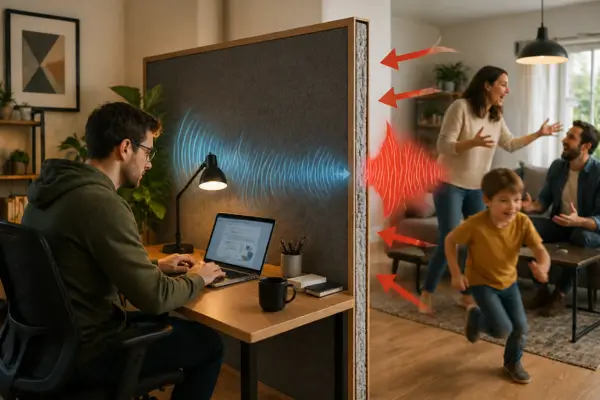
Sound rarely travels in a straight line. It spreads sideways, slips through open areas, and gains strength when it reflects off hard surfaces. Once you start paying attention to its path, the problem becomes easier to manage—it gains direction.
This is where your divider stops being decorative and starts becoming functional.
Its placement matters more than anything else. If noise is coming from a doorway, hallway, or a high-traffic area, that’s exactly where your barrier should sit—between the source and your workspace.
For this first layer of defense, rigid materials work best. MDF panels between 10–15 mm thick, plywood, or even lightweight wood can create enough resistance to significantly reduce direct sound impact.
In practical terms, the height should cover the most sensitive area of your body while working—from desk level to above your head. Positioning the panel close to your desk or aligning one side with a wall further limits the paths sound can take around it.
When placed correctly, the difference is immediate: noise no longer reaches you with the same intensity.
Combine materials to soften sound within your space
Blocking sound is only the first step. What happens after that matters just as much.
As noise hits a rigid surface, part of it is blocked—but another portion reflects back into the room, continuing to circulate. That’s why a divider made of wood alone only solves part of the problem.
A more effective approach combines materials.
The rigid base—like MDF or plywood—acts as the primary barrier. On top of that, adding a softer layer such as thick felt, acoustic batting, or mineral wool helps absorb part of the remaining sound energy.
Finishing it with a dense fabric like twill or linen improves how sound behaves around the structure.
In practice, this combination doesn’t just block noise—it softens the entire environment. The sound loses intensity and stops bouncing back as aggressively, creating a more stable and comfortable workspace.
Reduce sound reflections around your desk
Even with a divider in place, the surrounding environment still shapes how you experience sound.
Hard surfaces continuously reflect noise. It doesn’t disappear—it simply changes direction, creating that persistent background presence that gradually wears you down.
Adjusting the area around your desk makes a noticeable difference.
Adding softer elements nearby helps break up these reflections. A fabric panel behind your chair, thicker curtains on one side, or even a dense rug can significantly change how sound behaves.
Here, the goal isn’t to block noise—it’s to reduce how much it circulates within the space. When reflections are minimized, sound feels less intrusive and easier to ignore.
The result shows up in your daily routine: less auditory fatigue and better focus over time.
Isolate the divider to prevent vibration from spreading
Beyond airborne noise, there’s another factor that often goes unnoticed: vibration.
When your divider is in direct contact with hard surfaces—like tile floors, walls, or furniture—some sound energy can transfer into vibrations and continue spreading through the structure. In this case, the panel stops acting purely as a barrier and starts contributing to sound transmission.
Preventing this is simpler than it seems.
Creating softer contact points already makes a big difference. Materials like rubber, dense EVA foam, thick felt, or neoprene placed at the base of the divider help reduce direct vibration transfer to the floor. If the panel touches walls or furniture, adding a thin strip of these materials between surfaces further limits unwanted resonance.
This adjustment doesn’t change the structure or placement, but it improves overall efficiency. The divider continues to block and absorb sound—without carrying it into other parts of the room.
It’s a subtle detail, but one that makes the final result far more consistent.
A more controlled space changes how you work
When sound stops interfering directly, your environment becomes more predictable. Focus holds longer, thinking flows more naturally, and work is no longer constantly interrupted.
A well-executed DIY acoustic divider doesn’t rely on complex solutions—it depends on smart decisions. Proper placement, the right combination of materials, thoughtful adjustments to the surroundings, and small details that prevent performance loss.
When these elements come together, the impact becomes clear in everyday work—not as complete silence, but as control.
And that sense of control is what turns a shared space into a truly functional work environment.
Once your environment stops competing with you, everything shifts. Focus becomes easier to maintain, tasks move forward with less resistance, and the overall effort required throughout the day decreases.
An acoustic divider won’t solve everything—but when used strategically, it changes enough to make your space work in your favor.
In the end, that’s what truly matters: moving from a space that constantly interrupts you to one that quietly supports your focus.