A teacher’s authority in a digital environment is built through details that people often don’t consciously notice, but immediately feel. One of the strongest of those details is steady eye contact, which conveys confidence, command of the subject, and respect for the audience on the other side of the screen.
The reality of remote work, however, creates a constant challenge: balancing attention between the camera lens and the notes, scripts, or meeting windows scattered across the monitor. That split focus often leads to the familiar “wandering gaze,” breaking emotional connection and making communication feel uncertain or improvised.
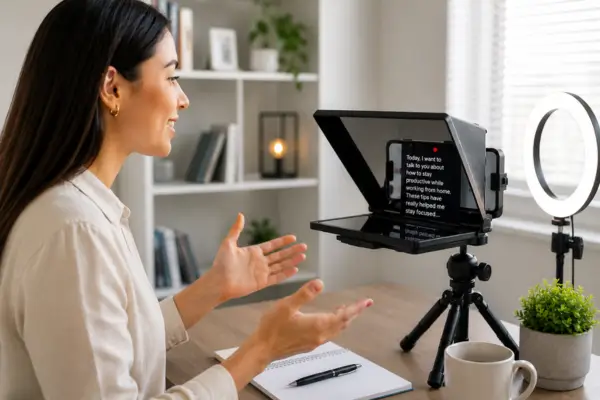
Compact teleprompters help solve this problem by allowing the technology to fade into the background so genuine, professional interaction can take center stage.
By adopting this tool, educators regain control of their delivery without needing to memorize long scripts or constantly look away to read slides. The device places information exactly where it needs to be: directly in front of the lens, yet invisible to viewers. That subtle shift changes how any class or meeting is perceived, raising the quality of the presentation to something closer to a studio-level production while still preserving the practicality of a home setup.
Understanding the logic behind this visual connection is the first step toward transforming the way your audience experiences your teaching.
Confidence Through Eye Contact
When we speak with someone who maintains eye contact throughout a conversation, we naturally feel more trust, attention, and connection. Eye contact communicates presence, confidence, and credibility in a quiet yet powerful way. In online classes, that connection is often lost whenever the teacher repeatedly glances away to check notes on another screen or read from a script placed on the desk.
Even when those movements are subtle, they interrupt the flow of communication and weaken the sense of engagement for the viewer.
Using a teleprompter removes that barrier by allowing continuous eye contact while the teacher follows a script comfortably and naturally. This visual consistency creates a smoother, more engaging experience for students and reduces the distractions caused by constant shifts in focus.
With the text positioned directly in the camera’s line of sight, educators gain more freedom to work on tone, facial expression, and speaking rhythm, creating presentations that feel more polished without becoming stiff. That sense of presence and clarity is one of the main reasons teleprompters have become such valuable tools in modern teaching and digital communication.
The Engineering Behind Transparency: Brands and Models
The core of a teleprompter is a beam-splitter glass system, commonly designed with a 70/30 transparency-to-reflection ratio. In practice, this allows the teacher to read the reflected text clearly while the camera, positioned directly behind the glass, captures the image without noticeable loss of sharpness or color accuracy.
Modern compact models are built to attach directly to camera lenses or monitors while taking up as little desk space as possible. Brands like Neewer, with models such as the X12 and X14 series, offer sturdy construction capable of supporting everything from smartphones to larger tablets, making them a strong option for users who value durability.
For those who prioritize portability and fast setup, Desview stands out with models like the T2 and T3, which are light enough to carry in a backpack for external recordings. Elgato, meanwhile, offers a different approach with its Prompter, which includes an integrated nine-inch display and removes the need for a separate tablet or smartphone.
This variety of options allows professionals to find the right balance between cost, functionality, and available workspace. Still, the value of this equipment goes far beyond reading pre-written scripts, especially when used strategically during live interactions.
Strategic Use in Live Meetings
One of the most useful and still underused applications of compact teleprompters is in live meetings on platforms like Zoom, Microsoft Teams, or Google Meet. Instead of looking down at a gallery of faces placed somewhere else on the monitor, professionals can move the video call window directly into the teleprompter’s reflective area.
The result is surprisingly effective: you can observe facial expressions and body language in real time while, from the other person’s perspective, you appear to be looking directly into their eyes.
This eliminates the sideways glance that is so common in online meetings and often unintentionally communicates distraction or lack of focus. That added sense of human connection becomes a meaningful advantage in sales meetings, mentoring sessions, or live classes. The other person feels genuinely heard and valued, which naturally improves communication, trust, and problem-solving.
At that point, the teleprompter stops being just a “reading tool” and becomes a true connection device, helping technology bring people closer together instead of creating distance. Beyond improving communication quality, this level of visual organization also creates a productivity gain that directly affects working time.
Radical Optimization of Production Time
One of the biggest frustrations for anyone producing educational content is the amount of time lost to recording mistakes and long editing sessions spent removing filler words, awkward pauses, or forgotten lines. The teleprompter directly addresses this inefficiency by allowing teachers to follow a precise and well-structured script.
The result is what many creators call a “first-take recording,” where the video is essentially ready right away or requires only minimal editing. This can reduce post-production time by as much as seventy percent, allowing educators to focus on creating new material instead of spending hours inside editing software.
Having the text directly in front of the camera also ensures that no important information is forgotten, preserving the level of technical accuracy expected in high-quality classes. Speaking becomes noticeably smoother because the teacher no longer has to spend mental energy trying to remember the next topic; instead, the lesson flows naturally from the structure already in place.
That reduction in cognitive strain helps prevent exhaustion during long recording sessions, keeping teaching quality consistent from the first video to the last. For this workflow to feel truly seamless, however, it is essential to master the reading technique so the delivery sounds natural rather than scripted.
Mastering Performance with Compact Teleprompters
The biggest fear for beginners using a teleprompter is sounding robotic, as if they are simply reading from a shopping list. The key to avoiding that effect lies in fine-tuning the scrolling speed and adjusting the distance between the teacher and the camera. When the device is positioned too close, side-to-side eye movements become obvious to viewers.
By stepping slightly farther back and increasing the font size, those movements become nearly invisible, creating the impression of spontaneous speech. Smart software solutions like PromptSmart make this process easier by using voice recognition to scroll the text only when the speaker is talking, naturally adapting to pauses and speaking rhythm.
Practice also plays an important role in learning how to treat the script as a guide rather than something that must be followed word for word. Teachers should feel comfortable improvising occasional comments or reactions during the presentation, since those spontaneous moments reinforce authenticity and make the delivery feel more human.
Mastering both the technical and performance aspects of compact teleprompters is what separates casual creators from professionals capable of turning a home office into a real platform of authority and influence. When used correctly, the technology becomes almost invisible, allowing knowledge, personality, and passion for teaching to take center stage.
The future of online work and education demands tools that support clearer and more human communication. A compact teleprompter is not simply a luxury accessory, but a strategic investment in both your professional image and your productivity. By integrating this solution into your daily routine, you move beyond many of the limitations of digital interaction and establish a higher standard of excellence in the way you communicate.
Ultimately, having control over your delivery is what allows you to build genuine connections with the people on the other side of the screen, transforming each class into a more memorable and engaging experience.