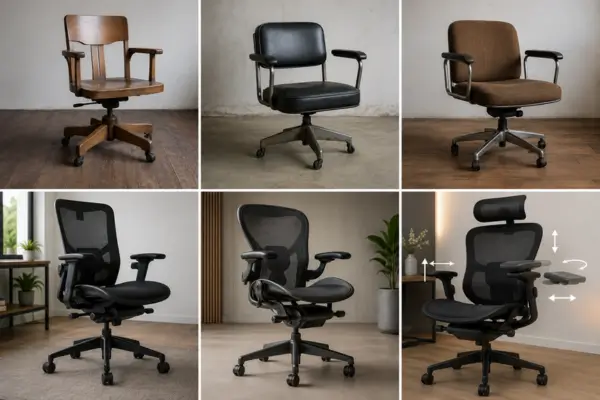
In the home office environment, the office chair is no longer just another piece of furniture — it becomes a central part of both health and performance. We spend a significant portion of our lives sitting, and the way the body interacts with this structure directly affects energy levels, concentration, and long-term well-being.
This article explores the evolution of the office chair, from its rudimentary origins to today’s sophisticated ergonomic engineering. We’ll uncover how the pursuit of comfort transformed a simple seat into a complex biomechanical support system, culminating in advanced synchronization mechanisms and highly personalized adjustments that define the cutting edge of modern ergonomics.
Discover the science behind your chair and how each technical innovation has shaped the way we work.
The Roots of the Office Chair: From Simplicity to Industrial Necessity
Before the Industrial Revolution, the concept of a chair specifically designed for administrative work simply did not exist. Seating was viewed either as a functional object or a symbol of status, with little concern for long-term comfort.
As bureaucratic work expanded within modern offices, that reality began to change. The office chair emerged as an essential item, but early models were little more than rigid adaptations of household furniture, lacking any meaningful ergonomic adjustments.
At the time, the primary goal was simply to provide a place to sit. Height adjustments and reclining mechanisms, when available, were extremely basic and largely ignored human physiology. Still, this era of purely utilitarian design would eventually give way to a new generation of furniture shaped by scientific research and a growing awareness of the importance of properly supporting the body throughout the workday.
The Ergonomic Revolution: The Birth of Comfort Science
The shift toward chairs designed around human well-being marked a major turning point during the 1970s and 1980s, when ergonomics became an applied discipline in industrial design. As awareness grew around the relationship between poor posture, physical pain, and reduced productivity, technical innovation accelerated rapidly.
This period saw the rise of the first truly ergonomic office chairs, developed using biomechanical principles. The release of the Herman Miller Ergon in 1976 is widely considered a historic milestone in occupational seating.
The focus of this generation centered on static customization, introducing features such as height adjustment, seat depth regulation, and fixed lumbar support.
Although revolutionary for their time, these adjustments still treated the human body as relatively static throughout the workday. The next frontier in ergonomic engineering would involve understanding that people are constantly moving, shifting posture, and changing position — requiring furniture capable of adapting dynamically in real time.
Tilt and Synchronization Mechanisms: The Core of Modern Ergonomics
As ergonomic principles became firmly established, innovation shifted toward improving the dynamic interaction between the user and the chair itself. Basic adjustments alone were no longer enough to support the complexity of a moving body.
This led to the evolution of reclining systems, introducing different approaches to postural support.
New mechanisms emerged, including permanent contact systems and “relax” mechanisms that allowed the seat and backrest to recline together. The eccentric mechanism introduced synchronized reclining with fixed movement ratios, but the real breakthrough arrived with the development of the Syncron mechanism.
This system allows the seat and backrest to move simultaneously at different ratios, typically 2:1. In practical terms, for every two degrees the backrest reclines, the seat moves only one degree. This calibration is essential for maintaining hip stability, preventing sliding, and reducing pressure on the thighs.
The Syncron mechanism also maintains continuous lumbar support during recline, adapting naturally to body movement while minimizing muscular fatigue. One of its greatest technical advantages is preserving an open angle between the torso and thighs, which promotes healthier blood circulation and reduces physical strain during prolonged sitting.
While older systems often required constant manual readjustments, Syncron mechanisms automate much of this postural compensation, allowing the chair to function almost like a fluid extension of the body itself.
Once designers optimized trunk support, attention naturally shifted toward the upper body, where ergonomic customization would reach an even higher level.
Understanding “4D”: Beyond the Main Mechanism and Into Armrest Personalization
While the Syncron mechanism coordinates movement throughout the torso, “4D” adjustable armrests take ergonomic personalization even further. It’s important to clarify that the term “4D” refers specifically to the multidirectional adjustability of the armrests — not the synchronization mechanism itself.
These armrests can typically be adjusted in four dimensions: height, depth, width, and rotation. This level of flexibility plays a crucial role in modern ergonomics because it allows the arms and shoulders to remain relaxed and properly aligned, significantly reducing chronic tension in the neck and shoulder blade region.
Properly adjusting armrests to both desk height and individual posture helps prevent harmful compensatory positions that often develop unconsciously throughout the day. The adaptability of 4D armrests complements the support provided by synchronization systems, creating a workspace where each part of the body receives appropriate biomechanical assistance.
It’s the combination of these technologies — the intelligence of the Syncron mechanism and the versatility of 4D armrests — that defines a truly high-performance office chair. Together, they help users maintain healthier posture and greater comfort throughout extended work sessions.
Yet the evolution of office seating is far from over, as the future promises even deeper integration between technology and everyday comfort.
The Future of the Office Chair: Innovation and Connectivity
The evolution of the office chair continues to accelerate. The future points toward increasingly intelligent seating solutions powered by advanced materials and digital technologies. New polymers, technical fabrics, and high-performance foam structures are being developed to provide greater durability while adapting more effectively to the body’s micro-movements.
At the same time, the rise of connectivity is transforming the chair into a smart device. Office chairs equipped with posture and pressure sensors are already being designed to deliver real-time feedback through mobile applications, notifying users about posture corrections or reminding them to take movement breaks throughout the day.
This integration enables continuous ergonomic optimization and may help prevent repetitive strain injuries before they develop into chronic conditions. Sustainability has also become a central priority, with manufacturers increasingly focusing on recycled materials and environmentally responsible production processes.
Ultimately, the office chair of the future will function as a complete ecosystem of support, intelligence, and environmental responsibility — designed not only to improve productivity, but also to make the workday healthier, more comfortable, and more responsive to human needs.
In the end, the evolution of the office chair — from rigid pre-industrial seating to today’s sophisticated synchronization systems and 4D adjustments — reflects an ongoing pursuit of healthier and more productive ways to work.
Investing in a high-quality chair is no longer simply about comfort; it is a practical investment in long-term well-being, focus, and performance for anyone working from home. Understanding the science behind these innovations allows for far more informed decisions, transforming the workspace into an environment that actively supports both the body and the mind.