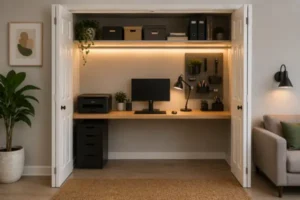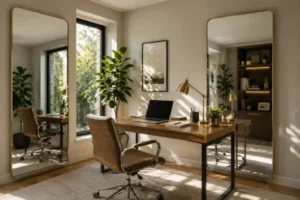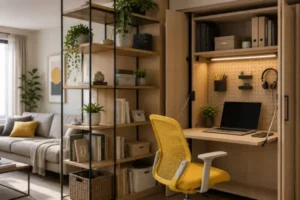
Working from home requires more than productivity skills — it also demands the ability to switch off professional mode and return fully to your personal space. In compact homes, one of the biggest challenges is the constant presence of work materials, whether that means nail polish bottles, fabrics, tools, supplies, or inventory.
This is exactly where hidden drawers and concealed storage systems become transformative. Hidden storage is not simply about concealing clutter. It is about creating a system where every work-related item has a strategic place to disappear.
The goal is to transform furniture you already own into “invisible” storage compartments, reducing visual stress and allowing your home office to fade completely from view once the workday ends.
What makes this approach so effective is that it creates a clear separation between professional and personal life without requiring extra square footage. The key is learning how to uncover usable space in places most people never think to look.
Hidden Drawers at Floor Level: The Engineering of Toe-Kick Storage
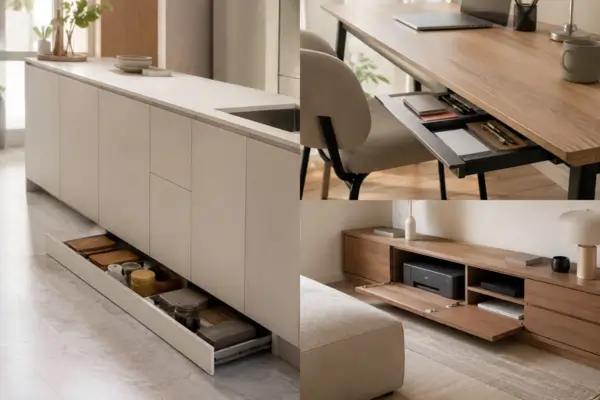
One of the most overlooked areas in any home is the recessed space beneath kitchen, bathroom, or office cabinets. In most cases, that 4- to 6-inch strip at floor level is sealed off with a fixed panel and completely wasted. The solution is to turn that dead space into toe-kick drawers.
Equipped with low-profile wheels and push-to-open mechanisms that can be activated with a gentle tap of the foot, these hidden drawers are ideal for storing flat objects or backup supplies that do not need constant access.
A nail technician, for example, could use them to organize reserve nail polish collections, sanding tools, or disposable materials. A craft maker might store large paper sheets, cutting templates, or specialty fabrics inside them.
The advantage is both practical and spatial. You gain meaningful storage capacity without losing a single inch of usable floor space in the living room, bedroom, or workspace itself.
The False-Front Trick: Tip-Out Trays and Pivoting Panels
That panel beneath a sink or desk that looks like a drawer but never opens? In many homes, it is simply a decorative false front. With a few simple hinges, however, it can become a functional tip-out tray.
Once installed, the panel tilts outward to reveal a slim hidden compartment, perfect for storing small tools and everyday essentials that would otherwise clutter the desktop.
For electronics technicians, this space can hold tweezers, precision screwdrivers, or adapters. For sewing professionals, it offers immediate access to scissors, measuring tapes, and pins without leaving items exposed all day long.
The same principle works beautifully with shelving systems. False backs inside bookcases or cabinets can discreetly hide routers, power strips, and tangled cables that instantly make a room feel chaotic. Magnetic or pivoting access panels keep wiring reachable within seconds while preserving a clean, polished appearance throughout the room.
Under-Desk Storage: Letting the Workspace “Breathe”
The desktop itself is usually the hardest surface to keep organized. In shared areas — especially dining tables or multipurpose rooms — the ability to clear everything quickly becomes essential.
Under-desk storage focuses on accessories attached directly beneath the work surface, keeping tools close without crowding the visible area.
Alongside slim drawers, an increasingly popular solution involves elastic storage nets and magnetic holders installed underneath the desk. These systems make it possible to secure metal tools, external hard drives, charging cables, or lightweight baskets filled with frequently used supplies.
For anyone running an online shop from home, under-mounted supports can hold tape dispensers, packaging labels, and shipping materials while leaving the tabletop completely free for order preparation.
The real advantage is flexibility. At the end of the day, the entire workspace can be cleared in seconds without carrying heavy boxes into another room or leaving visible traces of work scattered throughout the house.
“Chameleon” Furniture: The Fauxdenza Concept and Hybrid Pieces
The term “Fauxdenza” — a blend of “faux” and “credenza” — refers to wall-mounted cabinets installed in a floating style so they resemble decorative living room furniture rather than workspace storage.
For remote workers, creators, and small business owners, this concept can completely transform how a home office fits into everyday life.
A floating sideboard in the living room can discreetly conceal a printer, sewing machine, portable nail station, or packaging supplies. Because the furniture remains suspended above the floor, the room still feels visually open — an important detail in smaller apartments.
This idea becomes even more useful when combined with hybrid furniture pieces. Storage ottomans with divided interior compartments, for instance, can function both as guest seating and as organized storage for files, tools, or product inventory.
The strength of this strategy lies in dual functionality. Every piece serves a social purpose while quietly supporting professional activities behind the scenes.
Curation and the Maintenance Protocol: The Daily “Reset”
No hidden storage strategy works without careful curation. The danger of having too many concealed compartments is creating what could be called “invisible chaos.”
For these systems to remain functional, hidden areas actually need to be more organized than visible ones.
- Organize by frequency of use: Store monthly-use items inside toe-kick drawers and everyday essentials beneath the desk.
- Use transparent containers: Clear organizers inside hidden compartments prevent unnecessary searching and internal mess.
- Commit to a 10-minute reset: At the end of each workday, every object should return to its assigned space.
That short daily reset is what allows a workshop, studio, or small business setup to become a peaceful living room again in just a few minutes.
Ultimately, the success of hidden storage is not about perfection. It is about creating systems that make organization easier to maintain naturally over time.
Functionality Without Letting Work Take Over Your Home
Hidden storage proves that a highly functional workspace does not need to dominate the atmosphere of your home. By transforming overlooked areas like toe-kicks, false panels, under-desk spaces, and hybrid furniture into discreet storage systems, it becomes possible to maintain both efficiency and visual calm within the same environment.
The most effective organization is often the kind you barely notice. You feel it in the reduced visual stress, the smoother workflow, and the ability to truly disconnect once the workday is over.
In the end, your home should still feel like a refuge. Thoughtful hidden storage simply ensures that your work has its own place — without permanently taking over yours.