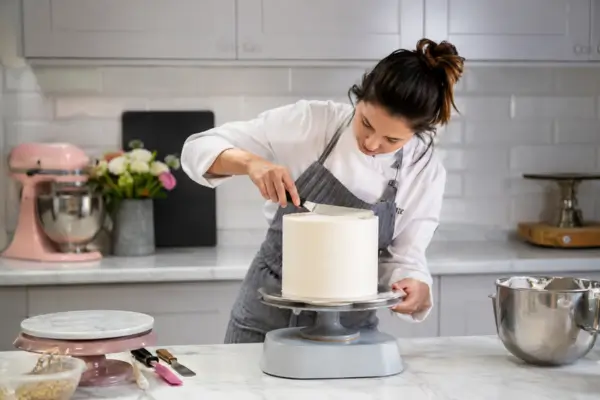
In the world of custom baking, perfection is always the goal. Every detail — from the shine of the frosting to the delicate shape of a sugar flower — takes patience, skill, and hours of focused work. But behind that dedication, there is often an invisible price: physical strain.
The image of a baker leaning over a three-tier cake late at night is far more common than people realize, and the strain of that routine is often felt in the spine, neck, shoulders, and wrists.
For many home bakers, cake decorating becomes physically exhausting long before they realize how much repetitive posture can affect comfort and workflow. Many assume ergonomics is something meant only for large commercial kitchens, but that is not true.
For bakers working from home and turning their kitchens into creative studios, ergonomics may be one of the most important tools they have. It does not just support the body — it can also improve consistency, control, and the overall quality of the final product.
This guide explores how small adjustments to counter height and cake stand positioning can support your body, improve workflow, and help elevate the finish of your cakes.
The first step is understanding a simple truth: one counter height does not work for every task. Different stages of baking require different working positions. Once you understand the logic behind an ergonomic workspace, production becomes smoother, more comfortable, and far more sustainable.
The Countertop Formula — Strength vs. Precision
Most home kitchens have standard countertops between 33 and 35 inches high. While common, that height rarely works perfectly for every baking task. Different types of work place different demands on the body, and understanding those differences is what turns a regular kitchen into a more functional workspace.
(Your height ÷ 2) + 2 inches
A useful starting point for calculating an ergonomic work surface is this simple formula:
For example, someone who is 5’3” would start with a counter around 33 inches high. But this is only a baseline. The real adjustment depends on the type of activity being performed. In baking, there are two main ergonomic work zones: the Strength Zone and the Precision Zone.
Strength Zone (Doughs and Heavy Mixing)
Tasks that require physical force — kneading dough, mixing thick batters, or handling large quantities of ingredients — work best on a slightly lower surface. The ideal height for this zone is usually between 29 and 32 inches.
A lower counter allows body weight to assist the movement naturally, reducing strain on the shoulders and lower back. Working with the elbows slightly above the surface also helps prevent unnecessary shoulder tension, one of the most common sources of fatigue during long baking sessions.
Precision Zone (Cake Decorating and Fine Details)
Tasks that require visual focus and delicate hand movements — such as frosting cakes, piping details, or working with fondant — usually need a higher work surface. The ideal range for this zone is generally between 35 and 37 inches.
Keeping the project closer to eye level reduces the need to lean forward or drop the neck downward for long periods. The result is better posture, steadier hand control, and a more comfortable decorating process.
For home bakers, creating these height variations does not require a kitchen remodel. A dining table may already provide the ideal lower surface for kneading, while sturdy risers, thick cutting boards, or raised platforms can temporarily lift part of the counter for precision work. The key is understanding that a single fixed height rarely supports every stage of baking efficiently.
But countertop height is only part of the equation. The way you interact with your cake stand also plays a major role in posture, comfort, and precision.
Raising Your Cake for Better Visibility
Once the counter height is adjusted properly, the next step is improving the position of the turntable or cake stand. One of the most common habits among bakers is leaning too far over the cake while trying to achieve smoother frosting or more detailed finishing work. Over time, that forward neck position creates pressure in the cervical spine and can lead to long-term discomfort.
The principle here is simple: bring the cake to your eyes instead of bringing your eyes to the cake.
Ideally, the top of the cake should sit around chest or sternum height while decorating. This allows you to work with a neutral spine, relaxed shoulders, and a direct line of sight to the cake surface without constantly bending the neck downward.
To estimate the correct elevation, combine the height of your precision counter with your own height. For example, if your decorating surface is 35 inches high and you are around 5’5”, the top of the cake should sit approximately 41 to 43 inches from the floor. In many cases, that means raising the turntable by 6 to 8 inches.
This adjustment can be made with surprisingly simple solutions. Strong monitor risers, reinforced wooden boxes, or even a wide, stable upside-down pot can work as affordable supports beneath the turntable. Stability matters more than appearance.
Raising the cake stand not only supports better posture, but also improves visual accuracy. Small imperfections in buttercream or ganache become easier to spot and correct, resulting in cleaner finishes and more professional-looking work.
Once the counter and cake stand are properly positioned, attention shifts to what supports the body from below. Long hours standing on hard kitchen floors place constant stress on the feet, knees, and spine — and that foundation matters more than most bakers realize.
Stable Feet, Better Posture — Support Starts from the Ground Up
Baking often means standing for hours on cold, unforgiving kitchen floors. Over time, that repetitive pressure travels upward through the ankles, knees, hips, and lower back.
One of the simplest and most effective solutions is using anti-fatigue mats. Typically made from dense rubber or polyurethane, these mats distribute body weight more evenly and reduce pressure on the joints. For bakers working on a tighter budget, thick EVA foam mats can provide a similar effect by softening impact and creating a more forgiving standing surface.
Another helpful technique is alternating foot support. Using a small step stool or sturdy box around 4 to 6 inches high allows you to place one foot slightly elevated while standing, then switch sides regularly.
This subtle shift changes pelvic positioning and relieves pressure from the lumbar spine, helping the lower back muscles relax naturally. Alternating every 15 to 20 minutes can make a noticeable difference during long decorating sessions.
Footwear matters too. Flip-flops may feel convenient, but they offer almost no arch support or postural stability. Supportive sneakers or professional kitchen shoes with proper cushioning are much better options for long-term comfort.
A slight heel drop — around 1 inch — can also help maintain a healthier spinal curve and reduce strain on the heels and plantar fascia during prolonged standing.
With the lower body properly supported, the next step is protecting the smaller joints responsible for precision work: the wrists, elbows, and shoulders.
Precision and Control — Ergonomics for Wrists and Shoulders
With the body properly supported and the cake positioned at the correct height, attention turns to the upper body, where most fine baking movements happen. Repetitive actions like squeezing piping bags, smoothing frosting, or handling decorating tools can place constant stress on the wrists, elbows, and shoulders.
The key to avoiding long-term strain is understanding movement efficiency and organizing the workspace with intention.
To protect the wrists, it is important to maintain a neutral hand position whenever possible, avoiding excessive bending or twisting. When using a piping bag, for example, the force should not come only from the fingers and wrist.
Instead, pressure should be distributed through the entire arm and shoulder while keeping the elbow relatively close to the body at roughly a 90-degree angle. This spreads the workload across larger muscle groups and reduces stress on smaller joints.
Workspace organization also has a major ergonomic impact.
The “16-inch reach rule” is a useful concept here: frequently used tools — piping bags, spatulas, decorating tips, food coloring, scrapers — should remain within easy reach without forcing you to stretch, twist, or repeatedly lift the shoulders.
Well-organized drawers, rotating trays, wall-mounted organizers, or simple countertop arrangements can dramatically reduce unnecessary movement throughout the day.
When your setup supports your body properly, precision comes from control and technique rather than muscular compensation. The result is cleaner work, less fatigue, and a more sustainable workflow.
Still, even the best ergonomic setup cannot replace recovery. The body was never designed to remain in the same position for hours without interruption. That is where strategic breaks become essential.
The Active Pause Ritual — The “Frosting Break”
In busy baking environments, breaks often feel impossible. Many bakers see them as wasted time or interruptions to productivity. In reality, short recovery periods are one of the smartest ways to maintain consistency, focus, and physical comfort.
A useful approach is the 50/5 rule: for every 50 minutes of focused work, take 5 minutes for movement and recovery.
These short pauses are not about stopping completely. They are about changing movement patterns and releasing accumulated tension before it turns into discomfort.
A few simple exercises can make a meaningful difference:
Forearm Stretch
Extend one arm forward with the palm facing down, then gently pull the fingers backward using the opposite hand. This helps release tension created by piping, spatula work, and repetitive hand movements.
Chin Retraction
To counteract forward head posture, gently pull the chin backward as if trying to align the back of the head with the spine. This reduces cervical compression and helps relieve neck tension.
Shoulder Blade Release
Slow shoulder rolls combined with gentle scapular retraction help reduce upper back tightness, especially after carrying trays or working with raised arms for extended periods.
Hydration and consistent nutrition throughout the day also play an important role in energy, concentration, and physical resilience.
Once breaks are treated as part of the workflow instead of interruptions, baking becomes more sustainable, productive, and manageable over the long term.
Ultimately, great baking is not only about technique, creativity, or presentation. The quality of your work is deeply connected to the condition of the body creating it. Treating baking like a profession that demands physical care — much like an athlete protects their body to perform consistently — is what allows passion, precision, and longevity to coexist in the same kitchen.