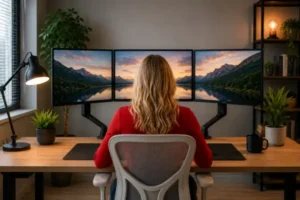
The search for a home environment that supports focus and well-being has become more important than ever. Working from home is no longer an exception — it has become part of everyday life for many people. At the center of this shift, lighting stands out as a powerful element, shaping not only how we see, but also how we feel, think, and perform.
More than simply brightening a room, light in its many forms acts as a silent conductor of our energy, mood, and daily rhythm.
Here, you’ll discover the intricate connection between natural and artificial lighting and our ability to thrive while working from home, as well as how small adjustments can create a meaningful impact on your daily routine.
The Science Behind Light: Its Impact on Circadian Rhythm and Productivity
Our bodies follow an internal clock known as the circadian rhythm, which regulates sleep and wake cycles, mood, and even metabolism. Light is the main signal that keeps this clock synchronized.
In the morning, exposure to bluish daylight — abundant in sunlight — tells the brain to reduce melatonin production while increasing cortisol, the hormone associated with alertness. The result is greater alertness, stronger concentration, and improved cognitive performance throughout the day.
As the day progresses and daylight becomes warmer and more golden, the body gradually shifts toward rest mode, stimulating melatonin release and preparing us for sleep. Ignoring these natural signals can disrupt the body’s balance.
This connection is widely supported by research. The Lighting Research Center (LRC) at Rensselaer Polytechnic Institute, for example, has shown that lighting designed to respect the natural circadian cycle can boost productivity by up to 12%, while also improving mood and reducing eye strain.
Studies such as Mills, Tomkins & Schlangen (2007), which explored the effects of color temperature in office lighting, and Viola et al. (2008), which investigated blue-enriched white light, further reinforce how proper lighting can improve both performance and sleep quality.
A lack of daylight — or too much exposure to poorly designed artificial lighting, especially at night — can confuse the biological clock and affect not only work performance, but overall health as well.
The good news is that this can be improved through intentional changes, starting with better use of the most powerful light source available: sunlight itself. But how can this be done in spaces that don’t always cooperate?
Maximizing Natural Light in Small Spaces: Smart Strategies for the Home Office
In many homes, the home office has to adapt to limited or challenging spaces. Making the most of daylight begins even before turning on the computer: it starts with choosing the right room.
Whenever possible, prioritize a space with good sunlight exposure. When positioning your workstation, the golden rule is to keep your desk perpendicular to the window. This setup helps prevent direct glare on the monitor, reducing uncomfortable reflections, while also keeping your own shadow from falling across the work area. The result is more balanced illumination throughout the day.
To enhance brightness in compact spaces, a few design strategies can make a remarkable difference. Mirrors, for instance, are more than decorative pieces. When placed strategically opposite or beside windows, they reflect sunlight deeper into the room and create a greater sense of openness.
Wall and furniture colors also play a major role. Lighter shades such as white, beige, or soft gray reflect light more efficiently, making the space feel brighter, larger, and more breathable.
At the same time, controlling daylight is just as important as maximizing it. Sheer curtains, adjustable blinds, or window films help regulate sunlight intensity, reducing excessive brightness and heat without completely blocking the connection to the outdoors.
Once daylight is properly balanced, artificial lighting becomes the next essential layer in creating an ideal workspace.
The Art of Artificial Lighting: Creating Layers of Light for Comfort and Focus
If daylight forms the foundation, artificial lighting is what refines and personalizes the work environment.
For a truly ergonomic and productive home office, the best approach is to create layered lighting, with each layer serving a specific purpose.
The first layer is ambient lighting — soft, diffused illumination that fills the room evenly and prevents harsh contrasts or heavy shadows. Ceiling fixtures or flush-mount lights with diffusers work particularly well for this purpose.
The second layer, and arguably the most important for productivity, is task lighting. This is focused light directed specifically at the work area, usually provided by a desk lamp. Adjustable height and brightness allow the light to be positioned exactly where it’s needed without causing glare on the screen.
As a general guideline, desk lamps should be positioned approximately 70 to 90 centimeters away from the work surface.
The final layer is accent lighting, which adds visual comfort and depth to the environment. LED strips placed behind a monitor, for example, help reduce the contrast between a bright screen and a darker room, minimizing eye fatigue. Wall sconces and indirect lighting can also create a space that feels both functional and welcoming.
Color temperature, measured in Kelvin (K), is another crucial factor. For activities that require concentration and alertness, lighting between 4000K and 5000K — often referred to as neutral white light — is generally the best choice. This range closely resembles midday daylight and encourages sustained focus.
On the other hand, prolonged exposure to lighting above 6000K, especially at night, should be avoided, as overly blue-toned light can interfere with the circadian rhythm and negatively affect sleep quality.
With artificial lighting properly planned, the next step is understanding how technology is transforming the way we interact with light itself.
Human Centric Lighting (HCL): The Future of Ergonomic Lighting
Imagine a lighting system that adapts to your body, your routine, and your needs throughout the day. That is the concept behind Human Centric Lighting (HCL).
Rather than simply turning lights on or off, HCL uses intelligent systems that dynamically adjust both light intensity and color temperature to mimic natural daylight patterns.
In the morning, the light becomes cooler and brighter, helping stimulate alertness and concentration. As the day progresses, it gradually shifts into warmer and softer tones, encouraging relaxation and preparing the body for rest.
When lighting stays aligned with the body’s natural circadian rhythm, the benefits become noticeable: improved well-being, better sleep quality, enhanced mood, and higher productivity.
Bringing HCL solutions into a home office is more accessible than many people assume. Smart bulbs with adjustable color temperature and brightness — connected through apps or voice assistants — allow users to create lighting scenes that naturally follow the rhythm of the day.
More advanced systems can even adapt automatically according to daylight availability and time of day.
What makes HCL especially valuable is its ability to create an environment that does more than illuminate a room. It supports both body and mind, helping optimize performance in a way that feels effortless and natural.
Ultimately, home office lighting goes far beyond the simple need to see clearly. It becomes a powerful tool capable of shaping well-being, improving productivity, and transforming the overall experience of working from home.
When daylight and artificial lighting are balanced thoughtfully — guided by ergonomic principles and a deeper understanding of how light affects the body and mind — the result is a workspace that does more than function efficiently. It becomes a place that genuinely supports focus, comfort, and inspiration.